The thinking
Odin sells a robot that fits the factory you already have. Show the arm like a product on a clean white floor, let the proof read like the robot's own vision, and give the software the room it needs to look easy.


Original. Odin Robotics' live homepage: a deep blue hero with Robot arms that do repetitive manual work in existing factories, a small CNC demo player on the right and Y Combinator and NVIDIA Inception logos under the buttons.
Reimagined. Our redesign of the hero: the same headline in blue and orange on white, beside a studio shot of a white robot arm with detection boxes labelled Backed by Y Combinator and NVIDIA Inception Program.
The business
Sells
A complete robot cell for one repetitive job on an existing line: arm, gripper, sensors and Odin's software, scoped, installed and changed when the parts change. Machine tending, picking from a conveyor, kitting and palletizing.
Who signs
Owners and operations leads at small and mid-size, high-mix factories that still do this work by hand and have no robot programmer.
What's at stake
A plant manager has to believe a robot will fit their floor before they send a video of the task. The site is their first look at the hardware and the software.
What the page does now
Every section sits on the same deep blue, with white type and a green highlight on "in existing factories". The hero shows a real CNC demo in a small player beside the headline, Y Combinator and NVIDIA Inception sit as small logos under the buttons, and the software, the part that adapts when the parts change, appears as a small screenshot halfway down the page.
What we kept
Their headlines and lines word for word ("Robot arms that do repetitive manual work in existing factories", "Different parts, Short runs, Constant change", "One system, set up around your task"), Send us a video of your task and Book a call, the Odin mark and wordmark, their blue, and the FANUC CRX-10iA, MuJoCo, Rerun and OpenCV steps from their own Studio demo.
What we changed
Constant change, with the evidence beside it.
Different parts, Short runs, Constant change sits beside the arm tending a fixture and a wrist camera finding the part, with a detection box on what it sees. The claim and its proof land in the same glance.
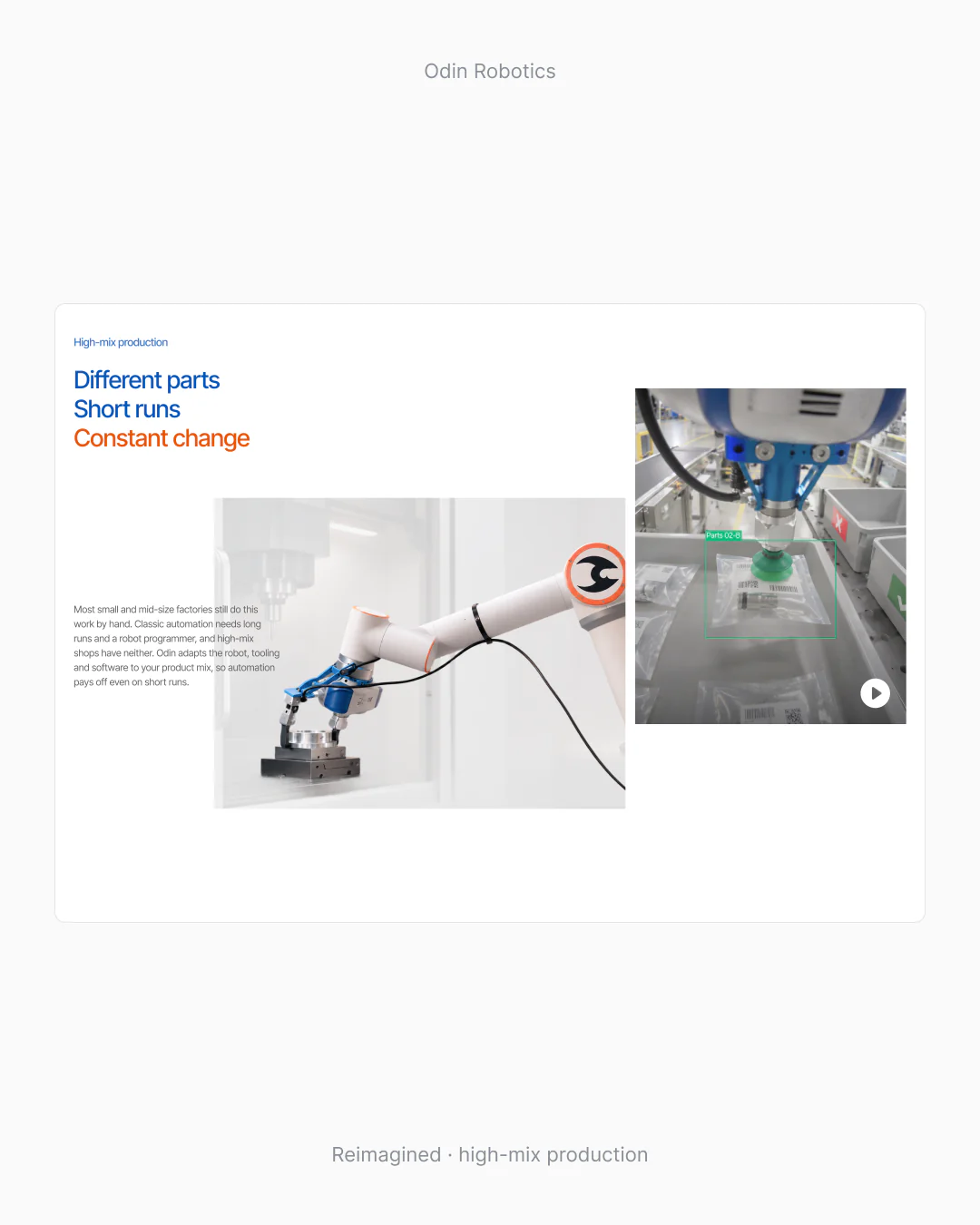
The high-mix section reimagined: Different parts, Short runs, Constant change beside a white arm tending a fixture and a wrist camera view with a green detection box on the part. The software, given a full screen.
Odin Studio shows the program as twelve plain steps, the digital twin and the camera in sync, and an assistant that turns one sentence into the program and simulates it before it runs. The part that adapts when the parts change is finally in view.
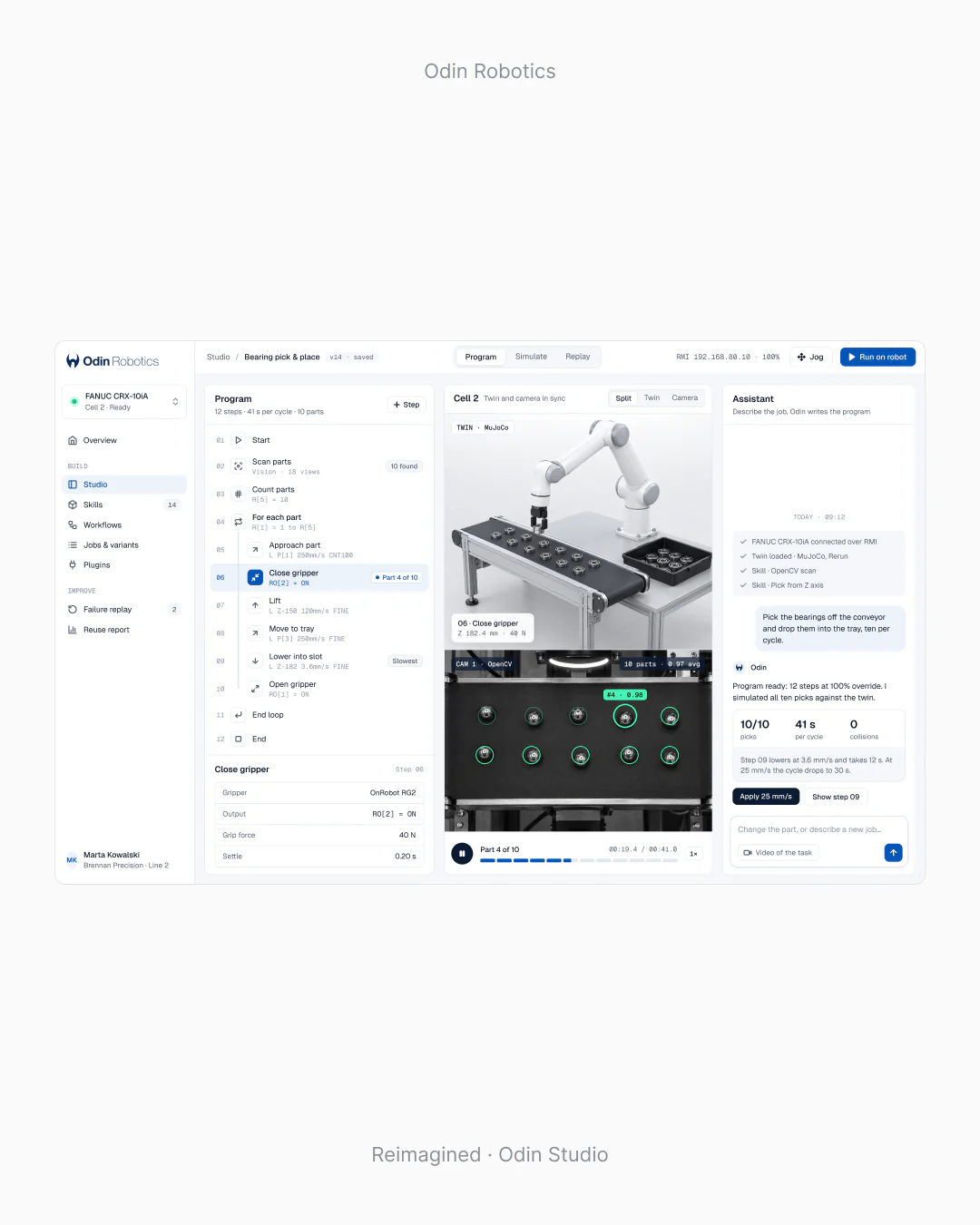
Odin Studio reimagined: a 12-step bearing pick program on the left, the MuJoCo twin above the OpenCV camera feed in the middle, and an assistant on the right reporting 10 of 10 picks at 41 s per cycle. One ask, with the arm up close.
The page ends on the gripper in close-up and one ask: send a short video of your process, or book a call.
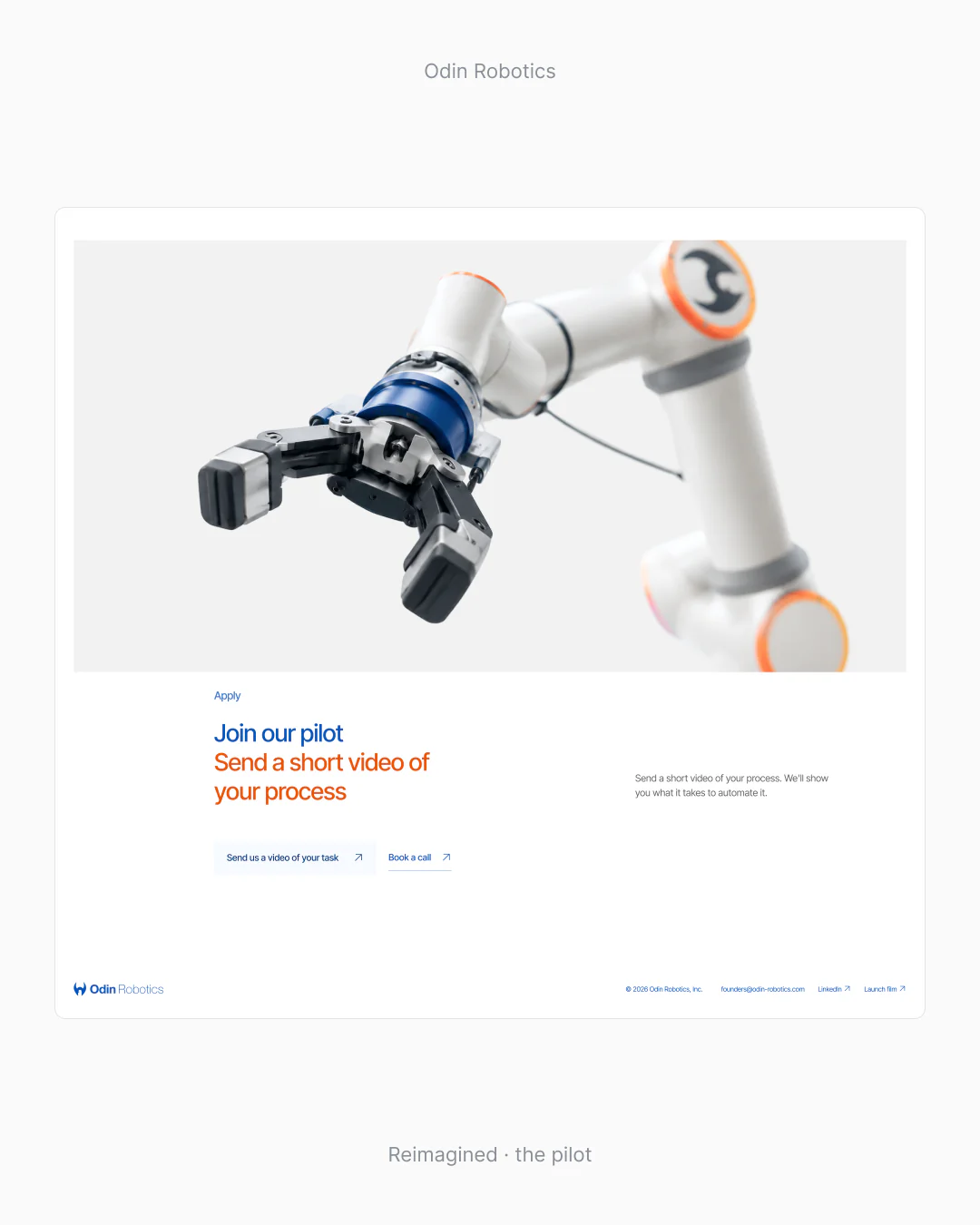
The closing section reimagined: a close-up of a white robot arm with a blue gripper above Join our pilot, Send a short video of your process, and two buttons.


Our hypothesis
More factories sending a video of their task, because the arm looks like equipment they could buy and the software looks like something their own people could run.
Invented for the concept
The arm renders, with the Odin mark on the joints, and the detection boxes are ours, made for the concept. In the Studio screen, the bearing job and its step values, 10 of 10 picks, the 41 s cycle, 0 collisions, and the operator Marta Kowalski at Brennan Precision are made up. The FANUC CRX-10iA, MuJoCo, Rerun and OpenCV steps come from Odin's own demo.